Inspirations
As reviewed in my reviews section. There are three main feature films that have influenced the storyline of this film.
In bruges has the most direct influence on the film. The scene in which music consumes the shots is something I am actually copying rather than taking ideas from. There are other ideas and themes taken from the film, such as the misconception of a character, believing one thing and that in turn leading to another important event. This happens in the Case of Harry played by Ralph Fiennes who mistakes a dwarf for a young boy. Harry is also an important character in the development of Nathan. I liked the idea that a character who is ultimately the bad guy is actually quite likeable. I've alway believed that someone who is not older than anyone he commands must have some sort of charm or wit to get to where they are with in their profession.
Crash has had an effect on my film through the time and the stories that it tells. The idea that film can run through a non-linear narrative is a commonly used technique, however, in crash it is unbeknownst to the viewer that these different stories are actually running at different times, as far as the viewed is concerned the characters may meet up some how but it will be in the future. For a character to be killed off and to realise that, that was the beginning of the film is a powerful tool that will hits the audience unexpectedly. I wanted to incorporate this sort of idea into my film. I like that two separate stories can merge into one, but it can be too obvious they are going to merge so to change the timeframes in which the stories are being told is actually a really unique way of keeping the audience guessing about the relationship between the main characters.
Dead man shoes is a film about a man taking revenge on those who killed his brother. Of course this is quite obviously a direct relation to events with in my film. The emotions felt by the character pave the way for the powerful question of is murder justified? can it be justified in certain circumstances? This is something I really want to address in my film. The idea that the this character that is committing atrocities is actually the good guy is an important part of the film and an idea I like in that of challenging stereotypes with in the films. I want to put my own spin of this which involves a similar plot to Seven (David Fincher 2004) in which the main character of Brad Pitt is coerced into doing something the audience knows he shouldn't do.
Style
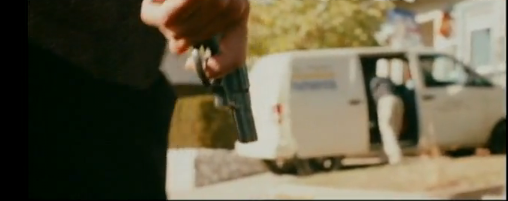
A shot used in both In bruges and Crash is that of the camera remaining it's focus on the gun as the character walks with it in his hand. This enhances the danger that the gun signifies. This is a shot that I think will work really well in my film and one I am hoping to use. It is also used in a four part drama called top boy. I can take huge amounts of inspiration from this as the last 20 minutes of the drama is effectively my film.
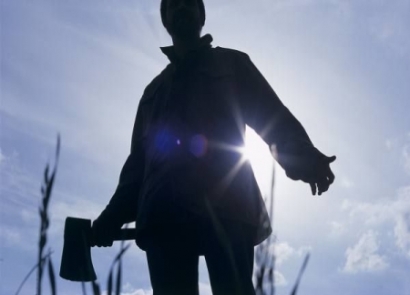
I want to use slow still shots to get across the mundanity of life in the city and to link the rich and the poor in the film. Much like dead mans shoes, the slow long drawn out shots give the idea of desolation in a place that is surrounded and I want to explore the characters loneliness that they all feel, something that may have led them to do drugs in the first place. This shot below is also an iconic shot I have drawn inspiration from when James walks into the house and is standing in the doorway with a gun by his side, his sillhouette is all that is needed to make the statement of power that he holds at that moment.
Music
This is an clip from the film Adulthood. From 5:28 is the moment in which I really take inspiration from. The music in particular is the driving force behind the inspiration. When he is locked in the bathroom and the music begins to build up tension. I think it could be quite similar to when Dan is kneeling over Robert and James spots him. The decision he makes to run is cowardly but also takes a lot of courage. This same sort of music is used in the film colourbleed which can be found on the bbc film network. 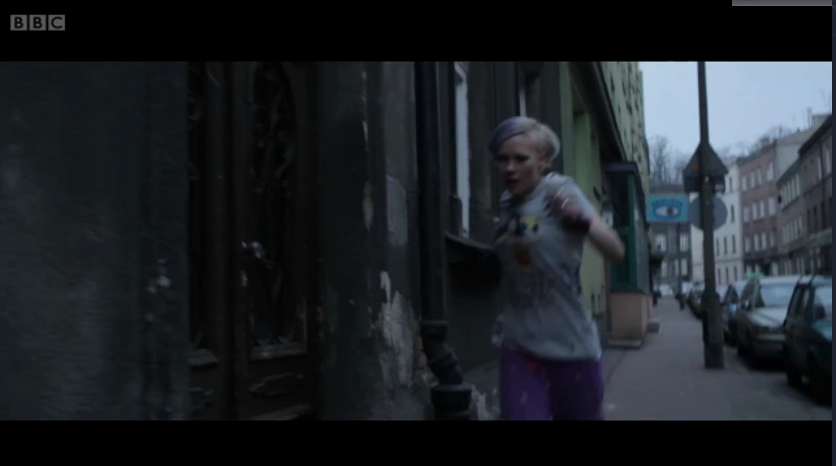 | This a music sequence from In bruges. The music sums up the mood of this scene and engulfs all the atmosphere around it. I believe this to be one of the greatest scenes in film. I think the music captures the emotions felt by the characters and the audience all in one. The shots flow beautifully with the music and it is a great influence to me especially for my final scene in which i want to keep the premise very similar. |
Theories
It is important that I link my film concept and idea to theories that there have been in the past. These theories will guide me on certain ways to make my film. Of course, they are all still just theories and as a result I am free to make up my own mind on how to make the film and what style to follow. However, it is important to have an understanding of theories and how my film relates to them, to show that I am a practitioner that grasps the conventions of film making and cinema. These are some theories I researched and related to my project.
Tarkovsky's theory of time (time-pressure):
Tarkovsky believed the film image not to be a composite of different shots arranged in a structure within a specific sequence progressing in time. He reasoned that if the film image is not a composite then the dominant factor of the film must be its rhythm. Rhythm is at the core of the “poetic film.” But Tarkovsky’s idea of rhythm is not that of Eisenstein, instead he envisioned cinematic rhythm as some kind of movement within the frame, and not as a sequence of shots in time. Hence, the main characteristic of poetic film is the process of sculpting in time as opposed to Eisenstein montage of attractions. While Eisenstein’s process of editing is guided by intellectual and conceptual juxtaposition of images, Tarkovsky’s time sculpting involves editing techniques which allow spontaneous unification of the shot as a self-organizing structure. Instead of the interplay of concepts (Eisensteinian montage), Tarkovsky creates the film image as an expression of the matter world, or simply the world. For Eisenstein, the concept dictated the cut; but for Tarkovsky, it is time that rules, dictating the editing techniques. Therefore, time within the frame expresses something significant and truthful that goes beyond the events on the screen and those in the frame; and so, the direct perception of time is like a pointer to infinity (this approach is quite different to the montage of attraction between shots where elements in the shot juxtapose concepts, making the viewer produce some intellectual link). While the montage of attraction produces a burst of meaning, arousing the viewer with the purpose to suggest specific ideas and concepts, Tarkovskian time rhythms illustrate a way of seeing life in its essence, life’s movements. Moreover, this poetic expression of the material world may go beyond the artist’s intention and be received differently by each viewer. In the TarkovskianSchool of film poetics, the filmmaker expresses his philosophy of life as opposed to creating a new perception of a social reality. http://www.horschamp.qc.ca/new_offscreen/deleuzian_pressure.html
Relation to An echo in the Dark - The final scene in An Echo in the Dark juxtaposes two different timeframes. Dan and Emma's world are running along aside James' but at different speeds. Everything Dan and Emma do is in real time although not presented in real time. As they kiss and hug there is longer amount of times away from camera than what it would seem when the shot returns to them. AS it cuts to James time has slowed down. James actions may not even really coincide with Emma and Dan's actions and it is unclear as to when James has entered and what Dan and Emma were doing at this time.
Vladimir Propps theory of fairy tales.
An example of the theories, codes and conventions that have changed and shape film such as An echo in the Dark are evident in cinemas more and more these days. Propps theory of narrative is subject to one of the oldest forms of storytelling. The fairytale. He believes there is always a set group of characters and set selection of events. The reason I am including this is becasue of the way in which I am breaking this theory. I believe it is interesting the way in which film makers increasingly try to break the boundaries of what is considered the original premise for a story. In many way I think an echo in the dark is a truely rebellious storyline when it comes to stand film narrative conventions. For example the narrative and characters are listed below of what is to be expected from a fairytale narrative.
Characters that perform a function
The Hero – a character that seeks something
The Villain – who opposes or actively blocks the hero’s quest
The Donor – who provides an object with magical properties
The Dispatcher – who sends the hero on his/her quest via a message
The False Hero – who disrupts the hero’s success by making false claims
The Helper – who aids the hero
The Princess – acts as the reward for the hero and the object of the villain’s plots
Her Father – who acts to reward the hero for his effort
Hero - James - The character the audience wants to see succeed.
villain - Dan - Arguably Nathan but is who James eventually sets out to kill.
Donor - Nathan - Provides James with a gun to aid his journey.
Dispatcher - Emma - Unknowingly sets the whole story off.
This is effectively where the comparisons end. We can see that propps theory holds some validity in that the characters can be connected to those of fairytales. There is alway going to be these charcacters and that is hard to break away from. However, in this James' 'quest' is not a w worthy one, the line beetween good and bad are becoming crossed and it is this style of film making that is pushing film making forward today and an aspect I am very interested in.
Actions as functions of narrative
Preparation
A community/kingdom/family is in an ordered state of being
A member of the community/kingdom/family leaves home
A warning is given to the leaders of the community or a rule is imposed on the hero
The warning is discounted/ the rule is broken
The villain attempts to discover something about the victim of the broken rule
The villain tries to deceive the victim to gain advantage
The victim unwittingly helps the villain
Complication
A state of disorder
The villain harms a member of the community/kingdom/family
One of the members of the community/kingdom/family desires something
The hero is sent to get what is desired
The hero plans action against the villain
Transference
The hero leaves home
The hero is tested or attacked/ he meets the test and is given a magical gift or helper
The hero reacts to the donor
The hero arrives at the place he can fulfil his quest
Struggle
There is a struggle between the hero and the villain
The hero is branded
The villain is overcome
The state of disorder is settlng
Return
The hero returns
The hero is pursued
The hero escapes or is rescued
The hero arrives home and is not recognised
A false hero claims rewards
A task is set for the hero
The task is accomplished
Recognition
The hero is recognised
The false hero or villain is unmasked
The false hero is punished
The hero attains the reward (princess/ kingdom)
To Propp events are not just about character and action but also about progressing the narrative.
Again, these theories are put to the test. Some events ring true but the ideas are being flipped on their head. So in conclusion I have taken influence from this theory in a big way. I have taken influence from it because I want to challenge it as opposed to follow it.
Todorov's theory of narrative
Todorov states that a story begins at an equilibrium and that the two opposing characters begin balanced. However, an event or incident occurs and disrupts this balance. The rest of the narrative is about the re-balancing of the situation.
This theory relates better to my plot line. Dan and James begin the film, in a non-timeline sense, as balanced characters who have never met. As the film progresses the film shows that they are disrupted by the action of Nathan and the disruptions that lead on from there.
